
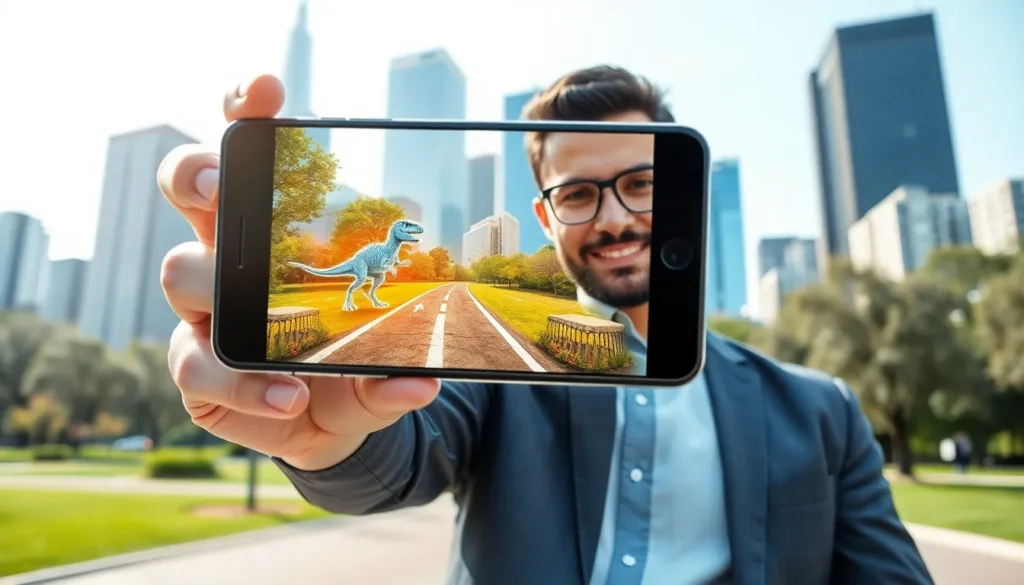
Imagine walking down the street and spotting an enormous dinosaur roaming the park, or finding your favorite coffee shop just by glancing through your phone. Sounds like science fiction, right? That’s the magic of augmented reality (AR), the technology that blends real-world scenes with digital elements. In this text, we’ll jump into the world of AR, exploring its definition, the technology powering it, its applications, and even its challenges. So, buckle up and prepare to see the world with a fresh perspective.
Understanding Augmented Reality

Augmented reality is a disruptive technology that seamlessly integrates digital information into our physical surroundings. Unlike virtual reality, which immerses users in a completely digital world, AR enhances the real world with computer-generated elements. This could include anything from basic information overlays to complex 3D models that interact with the environment. A perfect example of AR in action is the popular mobile game Pokémon GO, which challenges players to hunt for virtual creatures layered over real landscapes using their smartphones.
In essence, augmented reality enriches our perception of reality, enabling individuals to experience a blended form of interactivity that can change how they view and interact with their environment.
The Technology Behind Augmented Reality
The backbone of augmented reality is a combination of several technologies working in harmony. At the core, it utilizes sensors, cameras, and processors found in everyday devices like smartphones and tablets. These components work together to analyze the real world through cameras and then overlay digital information onto that view.
Key technologies include:
- Computer Vision: This is the primary method by which AR systems identify physical objects and surfaces. Using algorithms and digital processing, AR can detect and interpret real-world surroundings.
- Depth Tracking: It helps the device understand the spatial layout of a scene. For example, depth sensors can determine how far objects are from the viewpoint of the camera, ensuring that virtual images are correctly positioned in relation to their physical counterparts.
- Display Technology: Most modern AR experiences occur on handheld devices, such as smartphones or tablets. But, the rise of smart glasses and headsets, like Microsoft’s HoloLens and Google Glass, offer users a more immersive AR experience that’s hands-free.
Applications of Augmented Reality
Augmented reality is not just a cool gimmick: it has a myriad of practical applications across various sectors.
- Education: AR can transform traditional learning, offering interactive experiences that can help students grasp complex subjects. Imagine biology classes that project 3D models of the human body, making anatomy come alive.
- Healthcare: Surgeons can use AR overlays during operations for greater precision, visualizing crucial data without taking their eyes off the procedure.
- Retail: Customers can try on clothes virtually through AR apps or see how furniture looks in their living room before buying.
- Gaming: Beyond Pokémon GO, other games use AR to merge physical play spaces with interactive digital content, invigorating classical gaming experiences.
- Navigation: AR-enhanced navigation apps can overlay directions on real streets, making getting from point A to point B easier and more engaging.
Benefits of Augmented Reality
The advantages of augmented reality are prompting more industries to adopt this groundbreaking technology.
- Enhanced Engagement: Users are drawn to interactive experiences. AR makes everything from shopping to education significantly more engaging and fun.
- Improved Efficiency: In industries like manufacturing and healthcare, AR can streamline processes, reducing errors and enhancing training. Technicians can access real-time data without leaving their workstations.
- Cost-Effective Marketing: AR campaigns, such as interactive advertisements or packaging, can capture consumer attention far more than traditional methods, boosting brand engagement and sales.
Challenges and Limitations of Augmented Reality
Even though the excitement surrounding augmented reality, it’s not without its hurdles.
- Technical Limitations: For all its potential, the technology depends heavily on device capabilities. Limited processing power can affect performance and user experience.
- User Acceptance: Some individuals feel uncomfortable using augmented features due to privacy concerns. There’s a fine line between enhancement and invasion of personal space.
- Content Creation: Developing high-quality AR content requires expertise and resources that may not be available to all businesses or developers.
The Future of Augmented Reality
As technology advances, the future of augmented reality looks promising. Integration with artificial intelligence could result in smarter, more intuitive AR systems that better understand user intent and surroundings.
Besides, as hardware improves, think lighter, more powerful AR glasses, adoption rates are likely to soar. Industries we cannot yet imagine may emerge, creating new job opportunities and enhancing existing ones. The potential for AR to change how we interact with the world is virtually limitless.